Daily Junction.mobi portal
Technology · October 18, 2026 · The Conversation · 5 min
The mission could help resolve how Mars’ two moons were formed.
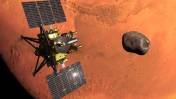
<div class="theconversation-article-body"> <figure> <img alt="MMX mission" src="https://images.theconversation.com/files/765404/original/file-20261011-50-kb97fk.png?ixlib=rb-4.1.1&rect=0%2C135%2C2600%2C1462&q=45&auto=format&w=754&fit=clip" /> <figcaption> The MMX spacecraft will enter Martian orbit before attempting to collect samples from Phobos. <span class="attribution"><a class="source" href="https://jda.jaxa.jp/result.php?lang=e&id=4d37fd592e1de337897edfa0b962a76c">Jaxa</a></span> </figcaption> </figure>
<span><a href="https://theconversation.com/profiles/daniel-brown-159342">Daniel Brown</a>, <em><a href="https://theconversation.com/institutions/nottingham-trent-university-1338">Nottingham Trent University</a></em></span>
<p>A Japanese space mission is about to launch towards Mars. But it will not land on the planet itself. Instead, the Martian Moons Exploration (MMX) mission will focus on Phobos, the bigger of Mars’s two small moons. </p>
<p>The mission will lift off on Monday October 19 at 20:41 BST on an H3 rocket from the Tanegashima Space Center, in the south of Japan. </p>
<p>This will start a <a href="https://www.science.org/content/article/audacious-space-heist-japan-aims-bring-home-bits-martian-moon">five-year mission</a>, during which the spacecraft will <a href="https://theconversation.com/topics/mars-178">orbit and explore Phobos</a>, deploy a lander, touch down and collect soil and small pebbles. In a world first, these samples will be delivered to Earth for study in laboratories.</p>
<p>MMX is led by the Japanese Aerospace Exploration Agency (Jaxa), in collaboration with the US, France, Germany and the European Space Agency (Esa). The <a href="https://www.mmx.jaxa.jp/en/science/">overall science objective</a> is to unravel the origins of the two Martian moons, the smaller of which is called Deimos. Mission scientists also want to examine the wider evolution of Mars and its local environment in space. </p>
<p>We still have no clear understanding of how the red planet <a href="https://theconversation.com/how-did-mars-get-its-moons-japans-mmx-space-mission-aims-to-solve-the-puzzle-294426">got its moons</a>. These natural satellites could have been hapless asteroids that were passing by Mars when they got captured by its gravity. </p>
<figure class="align-center zoomable"> <a aria-label="Zoomable image" href="https://images.theconversation.com/files/765406/original/file-20261011-50-8ya2o1.jpg?ixlib=rb-4.1.1&q=45&auto=format&w=1000&fit=clip"><img alt="Mars' moon Phobos." src="https://images.theconversation.com/files/765406/original/file-20261011-50-8ya2o1.jpg?ixlib=rb-4.1.1&q=45&auto=format&w=754&fit=clip" srcset="https://images.theconversation.com/files/765406/original/file-20261011-50-8ya2o1.jpg?ixlib=rb-4.1.1&q=45&auto=format&w=600&h=375&fit=crop&dpr=1 600w, https://images.theconversation.com/files/765406/original/file-20261011-50-8ya2o1.jpg?ixlib=rb-4.1.1&q=30&auto=format&w=600&h=375&fit=crop&dpr=2 1200w, https://images.theconversation.com/files/765406/original/file-20261011-50-8ya2o1.jpg?ixlib=rb-4.1.1&q=15&auto=format&w=600&h=375&fit=crop&dpr=3 1800w, https://images.theconversation.com/files/765406/original/file-20261011-50-8ya2o1.jpg?ixlib=rb-4.1.1&q=45&auto=format&w=754&h=472&fit=crop&dpr=1 754w, https://images.theconversation.com/files/765406/original/file-20261011-50-8ya2o1.jpg?ixlib=rb-4.1.1&q=30&auto=format&w=754&h=472&fit=crop&dpr=2 1508w, https://images.theconversation.com/files/765406/original/file-20261011-50-8ya2o1.jpg?ixlib=rb-4.1.1&q=15&auto=format&w=754&h=472&fit=crop&dpr=3 2262w" sizes="(min-width: 1466px) 754px, (max-width: 599px) 100vw, (min-width: 600px) 600px, 237px"></a> <figcaption> <span class="caption">Phobos measures just 22km across; its gravity is too weak to pull it into a sphere like Earth’s moon.</span> <span class="attribution"><a class="source" href="https://science.nasa.gov/mars/moons/phobos/">NASA/JPL-Caltech/University of Arizona</a></span> </figcaption> </figure>
<p>Another possibility is that that they formed when an asteroid collided with Mars, causing rocky material to be thrown out into space. Gradually, this material coalesced into Phobos and Deimos. The MMX mission will give us Phobos’s chemical composition, which could help distinguish between theories.</p>
<p>Grabbing samples from Phobos will be no easy task, however. Russia tried this in 2011 with its Phobos Grunt mission. The spacecraft launched successfully to low Earth orbit, but <a href="https://www.esa.int/Space_Safety/Space_Debris/Space_debris_experts_confirm_estimate_for_Phobos_Grunt_reentry">failed to fire its engines</a> to send it toward Mars. </p>
<p>However, Jaxa is well placed to succeed. The space agency has already proved that it can return samples from asteroids with its <a href="https://www.isas.jaxa.jp/en/missions/spacecraft/past/hayabusa.html">Hayabusa space missions</a>, which lasted from 2003-10 (Hayabusa) and 2018-20 (Hayabusa 2). </p>
<p>MMX will trial sophisticated sampling techniques designed for Phobos’s low gravity. The moon has about 0.1% the gravitational pull that Earth does. This means that a human on Phobos could jump a distance of 1.5 km horizontally without much effort. </p>
<p>The mission will also be a test of communication between the spacecraft and a <a href="https://www.isas.jaxa.jp/en/about/facilities/usuda.html">newly developed ground station</a>. After launch and deployment, MMX will take a year to reach Mars, arriving in August 2027. It will first circle the red planet before slipping into orbit around Phobos about a month later.</p>
<figure> <iframe width="440" height="260" src="https://www.youtube.com/embed/yiS6NdpEL2A?wmode=transparent&start=0" frameborder="0" allowfullscreen=""></iframe> <figcaption><span class="caption">MMX mission animation (Jaxa).</span></figcaption> </figure>
<p>The spacecraft consists of <a href="https://www.esa.int/Science_Exploration/Space_Science/MMX_factsheet">three modules</a> with distinct functions: a propulsion module to get MMX into orbit around Mars, an exploration module with landing and sample collection gear and a return module to deliver the sample to Earth. </p>
<p>The mission will make use of 13 <a href="https://www.mmx.jaxa.jp/en/science/#instruments">science instruments</a> to explore Phobos. High resolution cameras <a href="https://link.springer.com/article/10.1186/s40623-021-01462-9">called Tengoo and Orochi</a> will map the surface and a <a href="https://link.springer.com/article/10.1186/s40623-021-01537-7">laser altimeter (Lidar)</a> will build up a picture of the moon’s contours. Lidar uses laser pulses to measure the distance from the spacecraft to features on the surface.</p>
<p><a href="https://link.springer.com/article/10.1186/s40623-021-01423-2">An infrared spectrograph</a> called MIRS will survey Phobos’s minerals, while a gamma ray and neutron detector, <a href="https://link.springer.com/article/10.1186/s40623-021-01509-x">called Megane</a>, will determine the moon’s elemental composition. From a greater distance, MMX will also gather data on Mars’s smaller moon Deimos.</p>
<figure class="align-center zoomable"> <a aria-label="Zoomable image" href="https://images.theconversation.com/files/765423/original/file-20261011-50-c1x8ym.jpeg?ixlib=rb-4.1.1&q=45&auto=format&w=1000&fit=clip"><img alt="Idefix rover." src="https://images.theconversation.com/files/765423/original/file-20261011-50-c1x8ym.jpeg?ixlib=rb-4.1.1&q=45&auto=format&w=754&fit=clip" srcset="https://images.theconversation.com/files/765423/original/file-20261011-50-c1x8ym.jpeg?ixlib=rb-4.1.1&q=45&auto=format&w=600&h=400&fit=crop&dpr=1 600w, https://images.theconversation.com/files/765423/original/file-20261011-50-c1x8ym.jpeg?ixlib=rb-4.1.1&q=30&auto=format&w=600&h=400&fit=crop&dpr=2 1200w, https://images.theconversation.com/files/765423/original/file-20261011-50-c1x8ym.jpeg?ixlib=rb-4.1.1&q=15&auto=format&w=600&h=400&fit=crop&dpr=3 1800w, https://images.theconversation.com/files/765423/original/file-20261011-50-c1x8ym.jpeg?ixlib=rb-4.1.1&q=45&auto=format&w=754&h=503&fit=crop&dpr=1 754w, https://images.theconversation.com/files/765423/original/file-20261011-50-c1x8ym.jpeg?ixlib=rb-4.1.1&q=30&auto=format&w=754&h=503&fit=crop&dpr=2 1508w, https://images.theconversation.com/files/765423/original/file-20261011-50-c1x8ym.jpeg?ixlib=rb-4.1.1&q=15&auto=format&w=754&h=503&fit=crop&dpr=3 2262w" sizes="(min-width: 1466px) 754px, (max-width: 599px) 100vw, (min-width: 600px) 600px, 237px"></a> <figcaption> <span class="caption">The mission will deploy a 25kg robotic rover jointly developed by France, Germany and Japan.</span> <span class="attribution"><a class="source" href="https://www.dlr.de/en/latest/news/2025/japan-and-dlr-strengthen-research-relations/idefix-rover">DLR</a>, <a class="license" href="http://creativecommons.org/licenses/by-nc-nd/4.0/">CC BY-NC-ND</a></span> </figcaption> </figure>
<p>The instruments will send back data that controllers will use to decide where and how to land the spacecraft on Phobos. </p>
<p>In early 2029, the MMX exploration module will deploy a small microwave oven-sized rover called <a href="https://www.youtube.com/watch?v=-a0e8AKOWg0">Idefix</a>, which has been developed jointly by Jaxa, the French space agency Cnes and the German Aerospace Center (DLR). Idefix will drop down onto Phobos’ surface from between 40 and 100m in altitude. </p>